We Valorize The Individual in Revolt (April 7, 1923)
Wednesday, April 8th, 2026The following is a *very rough* machine translation of a 1923 text that appeared on the front page of Italian language newspaper L’Adunata dei refrattari, from which this project proudly cribs it’s name. In a time of anarchy’s continued regression towards liberal reform, it’s of the utmost importance to revisit and recall the more subversive words and ideas from lifelong anarchists in revolt. The editors and contributors to this paper emerged from the various circles of individualist and communist anarchists often regarded as the Galleanisti, namely Raffaele Schiavina and Osvaldo Maraviglia (both of whom participated in Galleani’s paper Cronaca sovversiva), and it’s within the lineage of this disparate group of uncontrollables that the Refractories project places itself. Links to PDFs of L’Adunata’s 1922-1971 run can be found here. – SM
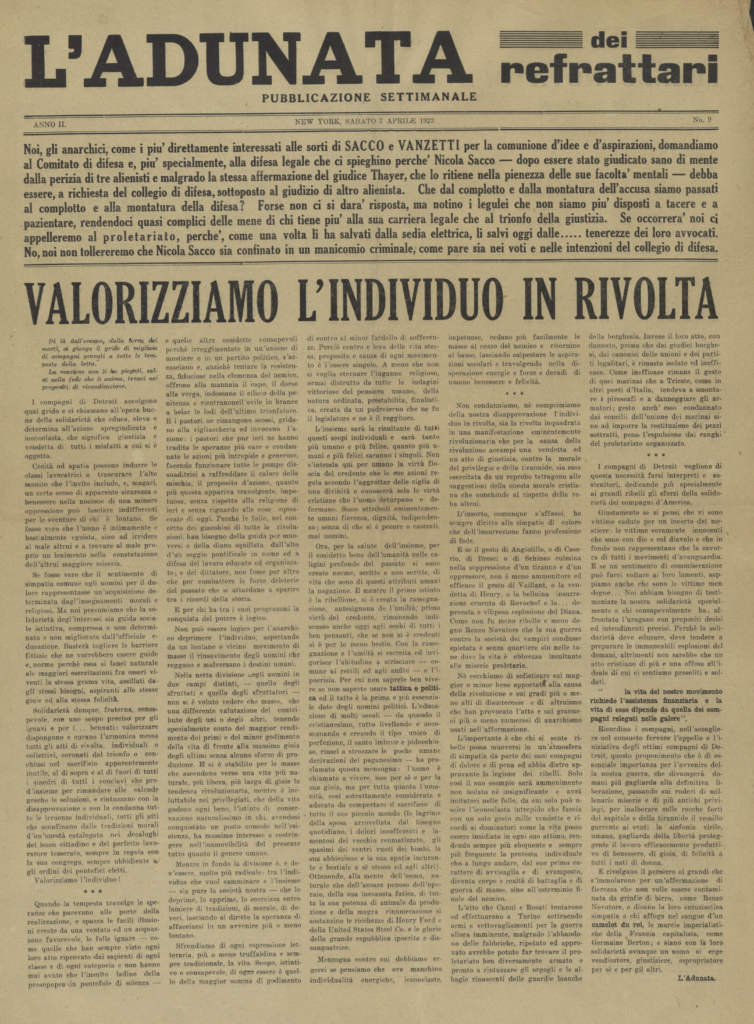
We Valorize The Individual In Revolt
From beyond the ocean, from the land of the dead, comes the cry of thousands of comrades tested by all the storms of struggle. The reaction has not broken them, firm in the faith that animates them, tenacious in their purpose of vindication.
The comrades of Detroit welcome this cry and call us to the good work of solidarity that educates, elevates, and leads to unscrupulous iconoclastic action, which means justice revenge for all the misdeeds to which we have been subjected.
Blindness or apathy may lead the working classes to disregard the profound warning that this call entails; indeed, a certain sense of apparent security and well-being—derived from the notion of diminished oppression—may leave them indifferent to the misfortunes of those far away. This would be true if man were, at his core, so beastially selfish as to mock the suffering of others, and to find solace for his own ills in the mere observation of another’s even greater misery.
If it were true that the feeling of sympathy common to men for pain represented an acquisition determined by moral and religious teachings. But we presume that solidarity of interests is an instinctive social guide, compressed and not determined and improved by official education. It will be enough to remove the fictitious barriers that pretend to be its guides and norms, for it to naturally launch itself into the greatest exertions among beings living the same miserable life, beset by the same needs, aspiring to the same joys and the same happiness.
Solidarity, therefore, fraternal, conscious, with a precise purpose for the lazy and the… well-born: to valorize, organize, and care for the harmonious balance of all acts of revolt, individual or collective, crowned with triumph or concluded in seemingly useless sacrifice, above and beyond all the Sanhedrin of all the confederates that preempt together to postpone solutions to the Greek calends, and blunt with disapproval and condemnation all individual impetuosity, all acts that transgress the moral traditions of an honesty catalogued in the Decalogues of the good citizen and the perfect card-carrying worker, always in good standing with his congregation, always obedient to the orders of the elected pontiffs.
Let us valorize the individual!
• • •
When the storm overwhelms the hopes that seemed on the threshold of realization, and sweeps away the facile illusions created by a favorable gust and downpour, the ignorant crowds — like those who have always seen their every act rebuked by the wise of every class and every category and have never received anything but the Ladin insult of pomposity in the slippers of science— and those others, so-called aware because they are regimented in a trade union or a political party, collapse and, rather than attempt resistance, confident in the enemy’s elementality, they offer their heads to the axe, their backs to the rod, don the hairshirt of penance and return to the fold in a herd to bleat the praises of the last victor.And the shepherds are shaken by this, cry out for cowardice and call for action: the shepherds who only yesterday betrayed their dearest hopes and condemned the most intrepid and generous actions, turning on all the deterrent pumps to cool the heat of the fray, the intention of action, the more it seemed overwhelming, impetuous, without respect for the religion of yesterday and without regard for the consecrated things of today. Because the crowds, in the view of the Jacobins of all revolutions, need a guide to move and the dirge sounded from the heights of a pontifical throne in the name and in defense of educated and organized labor; and of a dictator, if only to combat the deleterious forces of the past that linger, disappearing among the memories of history.
And for those who have the conquest of power among their plans, it is logical.
It cannot be logical for the anarchist to depress the individual, expecting from a distant or near-future mass movement the recovery of the men who govern and misuse human destinies.
In the clear division of men into two distinct camps—that of the exploited and that of the exploiters—we have sought only masses, and only a different assessment of the contribution of one or the other, taking into account especially the greater productivity of the former and the lesser enjoyment of life compared to the greater joy of the latter, without any effort at production. And the revolutionary tendency has been established for the masses who ascend toward a more natural, freer, and more joyous life, while the instinct for self-preservation, most natural in those who, having “earned themselves a comfortable place in existence,” have the greatest interest in forcing the entire human race into the immovability of the present.
While ultimately the division is, and must be, much more radical: between the individual who wants to move forward and the whole —even our society—that depresses him, oppresses him, coerces him within barriers of traditions, morals, and duties, leaving law with the hope of emerging in a more or less distant future.
Let us strip life of every literary expression, more or less fraudulent and always traditional. The goal, instinctive or conscious, of every being is the greatest amount of enjoyment against the least burden of suffering. Therefore, the center and lever of life itself, the purpose and cause of every movement, is the individual being. Unless, of course, we wish to perpetuate the religious deception, now destroyed by all the victorious investigations of human thought, of an ordered, pre-established, purposeful nature, created by an Eternal Father who was its legislator and is its ruler.
The whole will be the result of all these individual goals and will be all the more humane and happier, the more humane and happier the individuals are. By “human” we do not mean the flaccid virtue of the believer, whose actions are governed by the frown of a divinity, and who will know only the Christian virtues that man disfigures and deforms. Pride, dignity, and independence are eminently human attributes; without these, one is a sheep or a castrated animal, never a man.
Now, for the health of the whole, for the so-called good of humanity, in the deep mists of the past, strict and unwritten rules of life have been created that negate these human attributes. And while the first instinct is rebellion, resignation has emerged, the forerunner of humility, the primary virtue of the believer, and it remains unquestioned even today in the eyes of all right-thinking people that if one is not a believer, one is at the very least a beast. With resignation and humility, the habit of crawling—common to reptiles and amphibians—and hypocrisy are exercised and strengthened. Therefore, you will not know how to live well if you do not know how to use tactics and politics, and tact is the first and most essential quality of politicians. The education of many centuries—since Christianity, by leveling and uniting everything and creating the single type of perfection, the holy, imbued and lousy, managed to strangle the few human derivations of paganism—has proclaimed this lie: man is called to live, not for himself and for his joy, but for all humanity, so abstractly considered and adored as to involve the sacrifice of his entire little world (the tears of the wife tormented by daily needs, the intolerant and complaining pains of the rheumatic old man, the spasms of the empty bellies of children, his abjection and his careless and bestial apathy towards himself and others). It is natural to the human mind that the laborious panting of the worker, his tireless toil, all his power as a production animal and his meager renumeration should be used to create the riches of Henry Ford and the United States Steel Co. and the glories of the great hypocritical and blood-draining republic.
A lie we must rise up against if we think that where energetic, iconoclastic, impetuous individuals remain, the masses will more easily yield to the enemy’s assault and return to the lower realms, allowing age-old aspirations to be trampled upon and overwhelming energies, strengths, and decades of human well-being and happiness into despair.
• • •
We neither condemn nor disapprove of the individual in revolt, whether the revolt is part of an eminently revolutionary demonstration that, for the cause of the revolution, seeks vengeance and an act of justice against the morality of privilege and tyranny, or whether it is carried out by a reprobate unmoved by the suggestions of honest Christian morality that concludes with respect for the property of others.
The insurgent, however he presents himself, always has the right to the sympathy of those who profess faith in the insurrection.
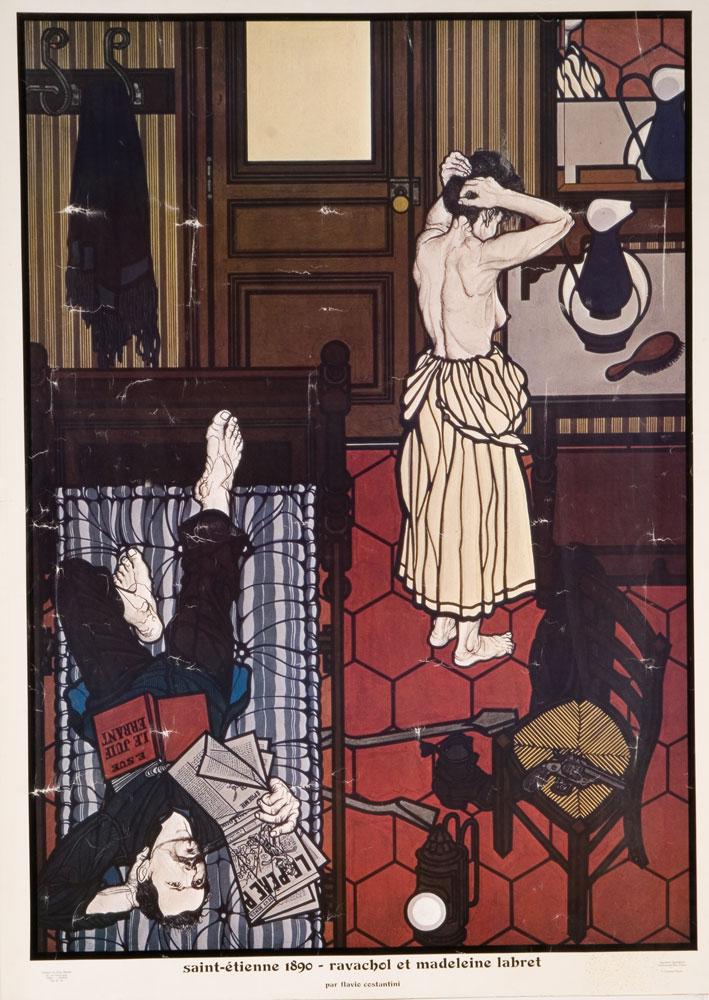
And if the gesture of Angiolillo, or of Caserio, of Bresei or of Schinas culminates in the suppression of a tyrant and an oppressor, the gesture of Vaillant, or the revenge of Henry, or the bloody and brutal insurrection of Rovachol and the… deprecated and vilified explosion of the Diana are no less warning and effective.
Just as Renzo Novatore was no less rebellious and worthy, he waged his war against the vampire society ruthlessly and mercilessly even into the dens where life is an insulting intoxication to the miseries of the proletariat.
Nor do we try to quibble over the greater or lesser good contributed to the cause of the revolution and the more or less high degrees of disinterestedness and altruism that provoked the act and the more or less numerous grains of anarchism used in the affirmation.
The important thing is that those who feel rebellious can move in an atmosphere of sympathy from their companions in pain and suffering, and have the legion of rebels behind them in approval. Only in this way will their example be a warning, neither isolated nor insignificant, and will they find imitators in the crowds, from which alone can emerge the intrepid iconoclast who, with a single gesture, can exact a thousand vengeances and remind the rulers how life can be threatened at every moment, making individual protest ever more eloquent and ever more frequent. Over time, from its initial character as a warning and outpost, it becomes the body and reality of battle and mass warfare, until the final extermination of the enemy.
The act that Canui and Rosati attempted and carried out in Turin, stealing weapons and supplies for the then imminent war, despite the factories being abandoned, had it been repeated and approved, could have left the proletariat much better armed and ready to blunt the resurgent pride and arrogance of the bourgeois White Guards. Instead, their act, condemned not only by bourgeois judges but also by the canons of the legalistic unions and parties, remained isolated and ineffective.Likewise, the gesture of those sailors in Trieste, as in other Italian ports, who attempted to dismantle steamships and harm the shipowners, remains ineffective; this act was also condemned by the councils of the sailors’ unions, to the point of requiring the return of the stolen pieces, under penalty of expulsion from the ranks of the organized proletariat.
• • •
The comrades of Detroit want to be interpreters and supporters of this necessity, dedicating the efforts of solidarity of the comrades of America more especially to the great rebels.
Rightly so, if one considers that there are victims who have fallen due to a professional error: the truly innocent victims who are with God and the devil and who ultimately represent nothing more than the dead weight of all avant-garde movements.
And if a feeling of commiseration can lead us to listen to their laments, we also know that they are the least worthy victims… We need to demonstrate our solidarity, especially with those who have consciously faced the hurricane with decisive intentions and clear intentions. Because solidarity must educate, it must tend to prepare for the inevitable explosions of tomorrow; otherwise, it would be nothing more than another Christian act and an offense to the ideal of which we feel ourselves to be proselytes and soldiers.
“The life of our movement requires financial assistance and its life depends on that of the comrades relegated to prison.”
May comrades, in welcoming with their usual fervor the appeal and initiative of our excellent comrades in Detroit, remember this resolution, which is of essential importance for the future of our war, which will flare up more vigorously tomorrow toward definitive liberation, passing over the ruins of age-old miseries and more ancient privileges, to hoist on the strongholds of capital and tyranny the banner flapping in the winds, the virile, humane, vigorous symphony of freedom protecting the work effectively producing well-being, joy, and happiness for all born of woman.
And let them turn their thoughts to the great men who sacrificed themselves for an assertion of pride that refused to be contaminated by the clutches of a policeman, like Renzo Novatore, and let them express their enthusiastic sympathy for those drowning in the blood of a camelot du roi, the imperialist marches of capitalist France, like Germaine Berton; and let them show their solidarity wherever a man stands as an avenger, executioner, expropriator for himself and for others.
L’Adunata.